

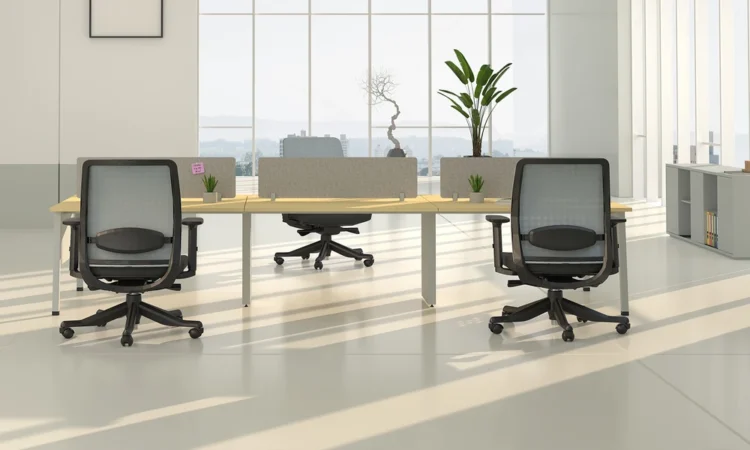
Nobody notices a good chair. They notice a bad one at about four in the afternoon, in the lower back, and then again the following morning. A chair is the one piece of office equipment in continuous physical contact with its user for eight hours a day, which is why choosing a Desk Chair on appearance or on price alone tends to be a decision people revisit within a year.
Fit Comes Before Features
A chair with fifteen adjustments that does not suit your body is worse than a simple one that does. Three dimensions matter most. Seat height should allow your feet flat on the floor with thighs roughly parallel to it. Seat depth should leave two to three fingers of clearance between the front edge and the back of your knees, since a seat too deep forces you to perch forward and abandon the backrest entirely. Backrest height and lumbar position should support the inward curve of your lower back rather than pressing against your shoulder blades.
The Adjustments That Earn Their Place
Seat height is essential and universal. Seat depth adjustment matters greatly for shorter and taller users and is often the difference between a chair that fits and one that nearly does. Adjustable lumbar support, both in height and firmness, is worth paying for. A recline mechanism with tension control lets the chair move with you rather than holding you rigid, and the ability to lock it at a working angle is useful. Anything beyond these is refinement rather than necessity.
Armrests Are Not Decoration
Armrests should support your forearms with shoulders relaxed and elbows near ninety degrees. Set too high they lift the shoulders into permanent tension; too low and you lean. Fixed armrests fit only the person they were designed around, so height adjustment is the minimum. Width and pivot adjustment help users who type close to the body or use a mouse far from it. If the armrests prevent the chair from sliding under your desk, they will end up unused, so check that clearance before buying.
Seat Material and the Climate
Foam cushioning is comfortable and supportive but insulates heat, which matters in an office where the air conditioning fails or in a home study without it. Mesh seats breathe considerably better and stay cooler over long sittings, at some cost in edge comfort. Fabric upholstery is the practical middle ground and handles daily use well. Leather and imitation leather look formal and trap heat noticeably. Consider how the chair will feel in the last hour of the day, not the first.
The Base, Casters and Cylinder
The parts nobody examines are the parts that fail. A five-star base in aluminium or reinforced nylon is standard and stable; anything less than five points is not. Casters must match the floor, since hard casters designed for carpet will mark and skate on vinyl or timber, and soft casters drag on carpet. The gas cylinder is the most common failure point in cheap chairs, showing up as a seat that sinks slowly through the morning, so ask what class of cylinder is fitted.
Setting the Chair Up Once You Have It
A well-chosen chair set up badly performs like a bad chair, and most people never touch the controls after the first day. Work through it in order. Set seat height from the floor so feet rest flat and thighs sit level, then raise the desk or add a footrest if the desk is fixed and too high. Set seat depth next, then lumbar height so the support meets the small of your back. Set armrests last, with shoulders relaxed. Finally set recline tension to your body weight so the backrest follows you rather than pushing back.
Task, Executive and Occasional Use
Match the chair to the hours. A task chair is built for full-day work and is where the budget should go. An executive chair prioritises presence and padding, and is often less adjustable than it looks. Visitor and meeting chairs are used for an hour at a time and need none of this. Buying executive chairs for a floor of people who sit at them all day is a common and expensive mistake, and any serious office chair specification starts by separating these three use cases.
Test It Properly
Sit for at least ten minutes, not ten seconds, and sit as you actually work rather than upright and attentive. Adjust every control while seated, because a chair whose levers cannot be reached in position will never be adjusted again. Recline fully and check the chair does not tip or feel unstable. If several people will use the same chair across shifts, prioritise the ease and range of adjustment over any single position’s comfort.
Warranty and Total Cost
Ask what the warranty covers and for how long: mechanism, cylinder, base, casters and upholstery are frequently covered for different periods. Ask whether spare parts are available locally, since a chair with a failed cylinder and no replacement is scrap. Spread across five years of daily use, the difference between a poor and a good Desk Chair works out at a few cents an hour, which is the right way to think about the price.