

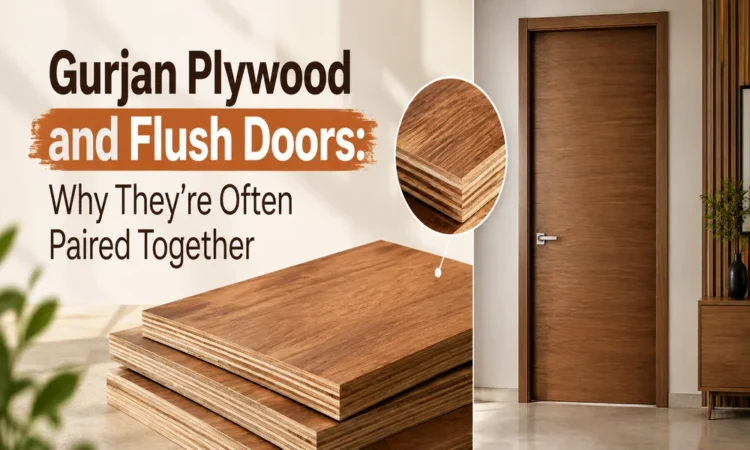
Even though flush doors can have a visually clean and simple surface, what’s underneath can affect a flush door’s performance characteristics tremendously. In the case of flush doors, the type of plywood used in constructing the door can provide the levels of strength and stability that are necessary to enable the door to operate efficiently (i.e., opening and closing, etc.) when using the hinges, locks and for repeat use (i.e., countless times) throughout the day. For this reason, and many others, Gurjan plywood is typically specified for flush door applications.
Gurjan face plywood is specified for flush door applications due to the suitable practical performance properties that are associated with the Gurjan species of hardwood timber. Some of the specific practical properties of the Gurjan species include: density and durability; dimensional stability; and screw-holding capacity. These are just a few examples of the reasons why Gurjan hardwood plywood is specified for flush door construction.
Strength is Required to Enhance Flush Doors
Gurjan is a hardwood timber from the Dipterocarpus genus and has a reputation for hardness, dimensional stability and screw-holding capability. The strength and durability of Gurjan hardwood plywood make it a viable option for use in the manufacture of flush doors and other types of applications where overall structural performance is critical.
Quality Flush doors experience the effects of opening and closing many times a day, so they must remain stable throughout the numerous cycles of opening and closing. Gurjan hardwood contains many of the properties required for securing hinges, handles, locks and other types of fixtures with reliable fastening locations, thereby allowing for the repeated opening and closing of a flush door.
Dimensional Stability in Flush Doors
The article links Gurjan plywood with dimensional stability, which is an important attribute of flush doors, as they tend to have large, flat surfaces. The real performance of flush doors is influenced by the way they are manufactured as a complete unit, including types of core, adhesives used to bond the plywood, how the veneers are layered, type of veneer thicknesses and how the flush door is installed and exposed to various types of environments.
Gurjan Face vs Gurjan Core Plywood
While the term ‘Gurjan plywood’ can imply that all layers of the plywood sheet were manufactured using Gurjan timber, this is not always the case. A Gurjan face plywood product has a veneer layer on the outer face that uses Gurjan timber. The core material may consist of another species of timber. Conversely, a Gurjan core plywood product uses Gurjan timber in the core construction of the plywood and is manufactured to the specifications set forth by the manufacturer.
This difference can be important when it comes to choosing plywood for flush doors. Buyers should carefully review the product specifications rather than relying solely on the term ‘Gurjan.’ The presence of consistent veneer-layers and excessive gaps or voids in the edge of the plywood can also be informative regarding the construction of the plywood.
Screw-Holding Capability for Door Hardware
Hardware for flush doors such as hinges, locks, handles and other items requires secure mounting for continued use of the door and its hardware components. Because of the repeated nature of the operation of flush doors, mounting points for hardware must be reliable. Gurjan plywood is characterised in the supplied materials for having excellent screw-holding capability and is therefore suitable for use as door hardware support.
Buyer’s Checklist for Gurjan Plywood
A buyer’s checklist before purchasing Gurjan plywood for a flush door would include confirming whether the product is a Gurjan face plywood product or a Gurjan core plywood product, inspecting the edge of the veneer layer for consistent layers and excessive gaps or voids, confirming the advertised thickness of the product, reviewing applicable certification documents, reviewing the manufacturer’s name and phone number and reviewing the applicable technical documents rather than only relying on the product’s cosmetic appearance or the price.
Environmental Conditions and Door Construction
Among the items that should also be considered by the buyer are the environmental conditions where the door will be located and the type of hardware that will be installed on the flush doors. The product materials supplied by Royale Touche for their flush doors describe the use of dual cores made from Southern Yellow Pine with Gurjan face veneers and waterproof construction and resist termites and borers, and has calibrated surfaces.
Conclusion
In conclusion, Gurjan plywood and flush doors are often used in tandem because the properties of Gurjan timber are able to meet the needs of several of the functional characteristics of flush door construction. Where it is necessary for the door to maintain dimensional stability and for the door hardware to maintain its reliability due to repetitive use, density and durability are desirable properties of Gurjan plywood.
Verification of the actual plywood construction must be done prior to purchasing plywood for flush doors. Because Gurjan face plywood and Gurjan core plywood have very different constructions, it is vital for buyers to review the specifications and appropriate technical documentation prior to making a buying decision. When matched properly, Gurjan plywood will form an appropriate foundation for durable flush doors.